The House
Not every poem is written in ink.
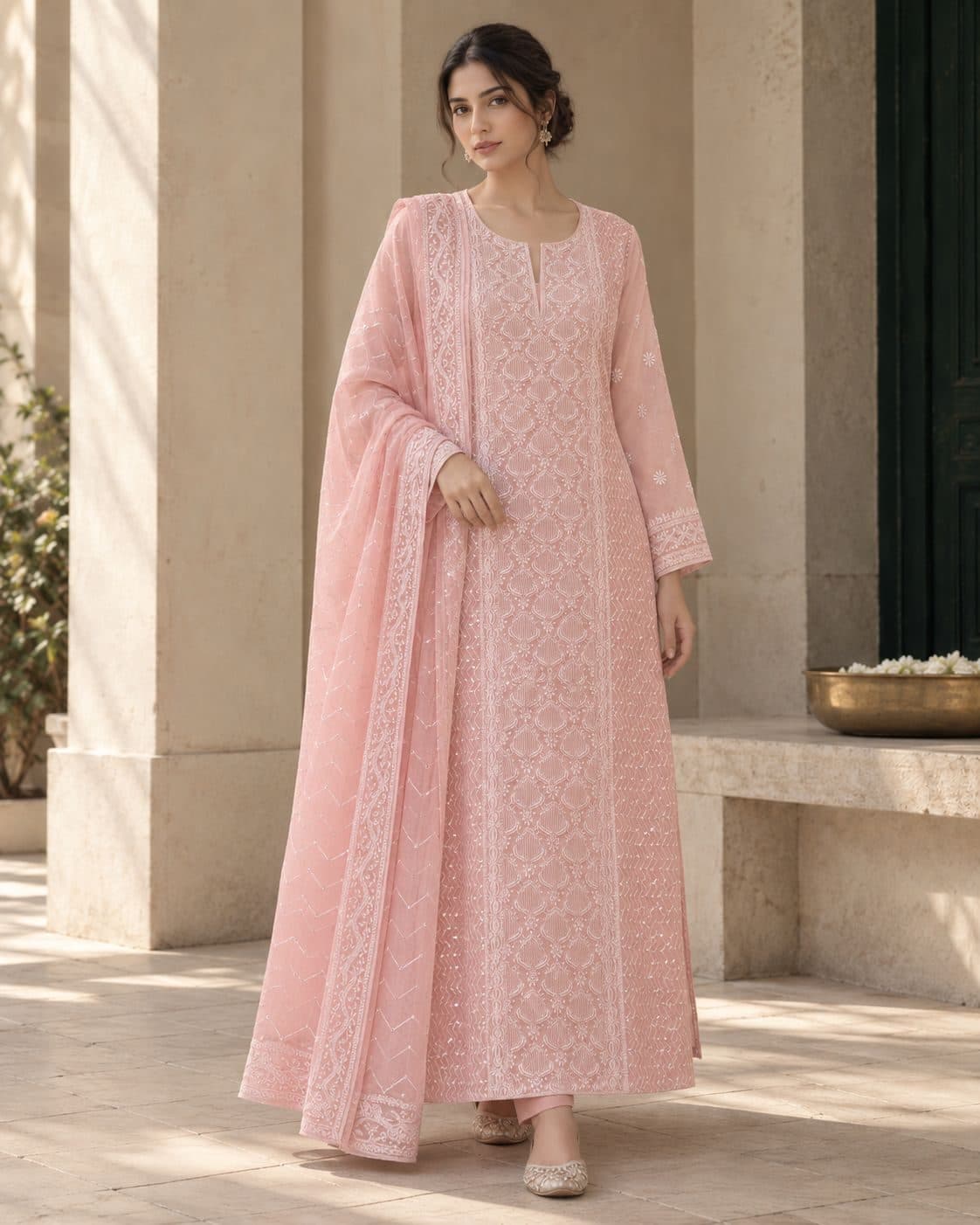
In Lucknow, some have always been written in thread. A stem drawn in tepchi. A petal raised in murri, a knot at its heart in phanda. Light let through cloth in jaali, without a single cut. Each stitch is placed the way a poet places a word: deliberately, in its own time, for the line that follows it.
NAZMEVA takes its name from the nazm, the Urdu poem, and its manners from a city known for its tehzeeb. Nazakat in the hand. Adab in the finish. Saadgi in the silhouette.
Every NAZMEVA piece is embroidered by hand, by karigars in Lucknow and the villages around it. A piece stays on the frame for fifteen days or for three months, as long as its detail asks. Nothing about it is hurried, because nothing about it can be.
We did not inherit a haveli or a hundred-year-old workshop, and we will not pretend to. What we inherit belongs to the city: a craft passed from hand to hand for generations. Our part is to give it the time it deserves, the cloth it deserves, and a house that treats each piece as a poem worth keeping.
We make for the woman who chooses for herself. The daughter at twenty-five, her mother at fifty, her grandmother at seventy-five. One collection, three ways of wearing it, and one day, a piece that passes from one of them to the next.
A poem in every stitch.
The name
NAZMEVA naz · meh · va
NAZMEVA is a name of our own making: nazm, the Urdu poem, and Eva, a name long read as life. A living poem.
What the house holds to
Poetic form
Every silhouette begins with balance and simplicity, and each piece carries a maker's note.
Slow craft
Fifteen days to three months on the frame. The time and the skill inside every stitch are the piece.
Living heritage
One collection for three generations, made to be worn, kept and handed down.